

Resilience and business continuity are how an organisation keeps operating through a disruption and recovers afterwards. In Australia, they draw on a family of standards — business continuity (ISO 22301), ICT readiness (ISO/IEC 27031), emergency planning (AS 3745) and crisis management (ISO 22361) — and on the discipline of exercising the plans before they are needed. This hub maps how they fit together.
Most organisations need more than one of these at once. A serious incident can demand emergency response, crisis leadership and business continuity in the same hour. Understanding how the disciplines connect is what turns a shelf full of plans into a coordinated response.
Overview
What are resilience and business continuity?
Resilience is the capacity of an organisation to absorb a disruption and keep delivering its most important services. Business continuity is the management discipline that builds the capacity to understand which activities matter most, how quickly they must be restored, and what it takes to keep them running when something goes wrong.
It sits alongside related disciplines. Emergency management protects life safety in the first minutes. Crisis management provides strategic leadership when the situation is serious or uncertain. ICT readiness ensures the technology the business depends on is recoverable. Together, they form a single resilience capability, underpinned by sound security risk management.
The pillars
The three pillars of resilience
Agilient groups the resilience and continuity disciplines into three pillars, each explained in its own guide. Exercising and testing are disciplines that cut across all three, validating each plan before a real event does.
Business continuity and ICT resilience
Keeping critical activities running and restoring technology in line with ISO 22301 and ISO/IEC 27031.
Emergency management
Facility emergency response under AS 3745: the emergency control organisation, wardens and evacuation planning.Read the guide
Crisis management
Strategic leadership and communications in a crisis, under ISO 22361.
Cuts across all three pillars
Exercising and testing
How they connect
How do continuity, emergency and crisis connect?
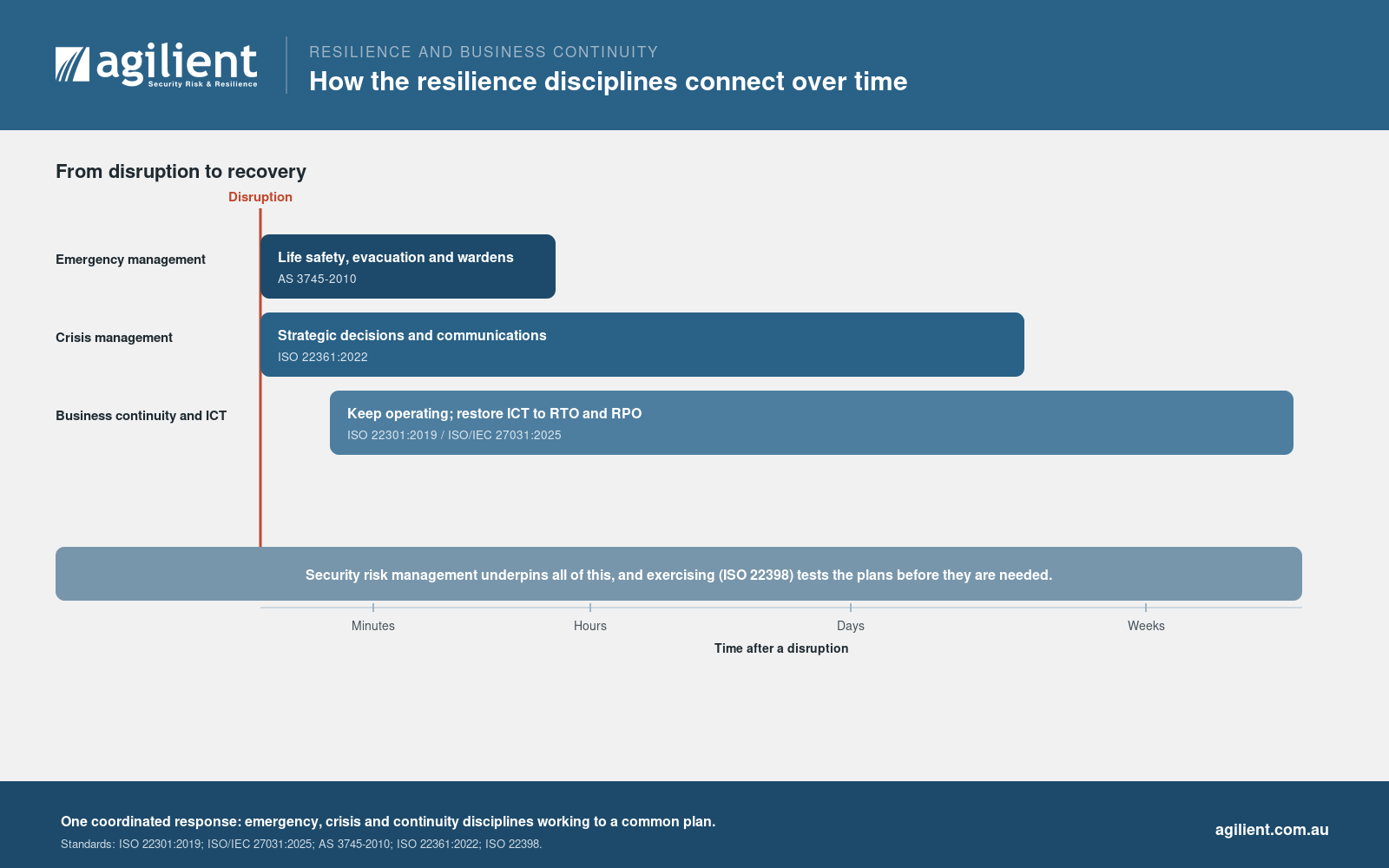
The disciplines are sequenced by how a disruption unfolds. In the first minutes, emergency management protects people and property. As the situation escalates, crisis management makes strategic decisions and handles communications, while business continuity keeps critical activities running, and ICT readiness restores the systems they depend on. Recovery and improvement follow.
They share a foundation. A single risk process identifies potential disruptions to the organisation, and exercising under ISO 22398 tests whether the plans actually work. Building these as one program, rather than separate documents, is what makes a response hold together on the day.
How we help
How Agilient supports resilience and business continuity
Agilient builds resilience programs that bring the disciplines together, from business impact analysis and continuity plans to emergency procedures, crisis structures, and the exercises that test them. The firm works across government, healthcare, aviation, defence and critical infrastructure, in Sydney, Melbourne, Brisbane, Adelaide, Canberra and regional Australia. Related work sits in the security and compliance frameworks hub, since resilience and security share the same risk foundation.
Build one coordinated resilience program
Agilient can bring your continuity, emergency, and crisis plans into a single program that holds together under real-world testing.
Talk to us about business resilienceor read about the service
FAQs
Frequently asked questions
What is the difference between business continuity and resilience?
Which standards cover resilience and continuity in Australia?
How do emergency, crisis and continuity management relate?
Where should an organisation start?

References
- Standards Australia, ISO 22301:2019 Security and resilience — Business continuity management systems — Requirements, standards.org.au
- ISO, ISO/IEC 27031:2025 Cybersecurity — Information and communication technology readiness for business continuity, iso.org
- Standards Australia, AS 3745-2010 Planning for emergencies in facilities, standards.org.au
- ISO, ISO 22361:2022 Security and resilience — Crisis management — Guidelines, iso.org