

Security risk management is the structured discipline of identifying the security threats an organisation faces, assessing the risk they pose, and treating that risk in a defensible way. In Australia, it is built on AS ISO 31000:2018, the risk management standard, and applied to security by the handbook SA HB 167:2025. It is the foundation that protective security, critical infrastructure and prudential frameworks all draw on.
For security managers, risk and governance leads, and any organisation that needs a defensible basis for its security decisions, the value is in the process rather than any single report. This page explains what security risk management is, the standards that govern it, how a security risk assessment puts it into practice, and why a single credible risk process can feed into several of the frameworks an organisation has to meet.
Overview
What is security risk management?
Security risk management is the structured process of identifying the security threats an organisation faces, assessing how likely they are and how serious their consequences would be, and deciding how to treat them. It applies the general principles of risk management to the specific problem of protecting people, information, assets and reputation from deliberate harm.
Unlike a one-off audit, it is a continuing cycle. The threat environment changes, the organisation changes, and controls that were adequate last year may no longer be adequate. A credible security risk management process gives an organisation a defensible basis for its security decisions and a clear record of why each control is in place.
The standard
AS ISO 31000:2018 and the risk management process
AS ISO 31000:2018, Risk management — Guidelines, is the current Australian standard for risk management. It is the Australian adoption of ISO 31000:2018 and replaces the earlier AS/NZS ISO 31000:2009. It sets out a process that runs from establishing the scope, context and criteria, through risk assessment — identification, analysis and evaluation — to risk treatment, with communication and consultation, and monitoring and review, running throughout.
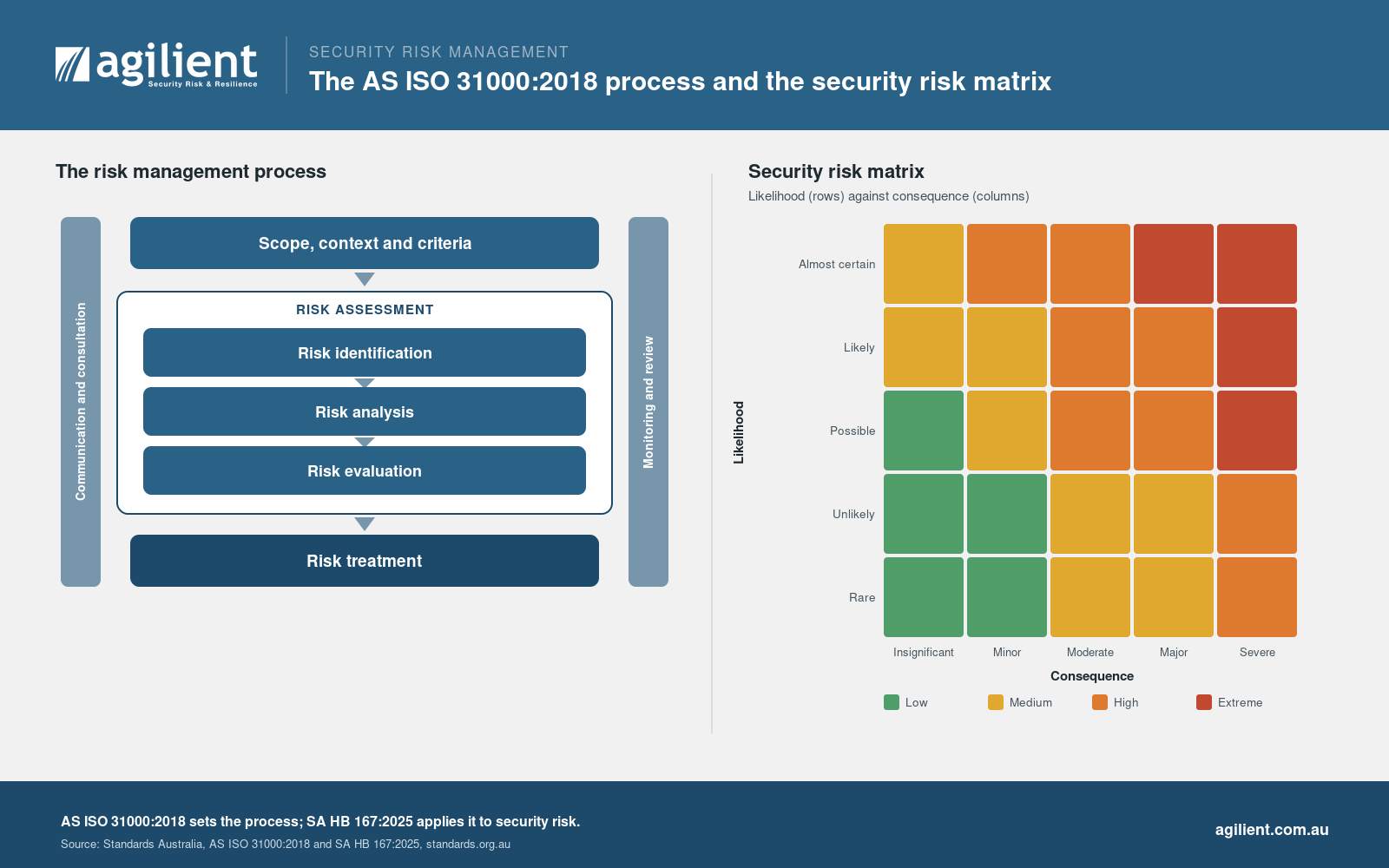
The standard is deliberately general. It gives the structure rather than the security-specific detail, which is where SA HB 167:2025 comes in.
Security focus
How SA HB 167:2025 applies the process to security risk
SA HB 167:2025, Managing Security-Related Risks, is the Standards Australia handbook that applies the AS ISO 31000:2018 process to security. It replaces the 2006 edition and was developed by the committee responsible for security and resilience. It provides guidance for executives, managers and practitioners on identifying and managing risks to people, assets, information and reputation, including threat and vulnerability assessment techniques such as scenario analysis and red teaming.
The handbook is designed to complement AS ISO 31000:2018 and references AS/NZS 5050 for managing disruption-related risk. In short, AS ISO 31000:2018 sets the process, and SA HB 167:2025 shows how to run it for security.
Starting point
The security risk assessment is the practical starting point
In practice, the process begins with a security risk assessment. A security risk assessment identifies the threats and vulnerabilities relevant to an organisation, analyses the risk each presents, and evaluates it against the organisation’s risk criteria, producing a prioritised picture that the rest of the program builds on. The security risk matrix shown above is a common tool for rating risks based on their likelihood and consequences.
A structured security risk assessment is usually the first engagement, and its output serves as the input for every other framework.
What is a security risk assessment, and how is it different from security risk management?
A security risk assessment is a structured evaluation that identifies the threats and vulnerabilities relevant to an organisation, analyses the likelihood and consequence of each risk, and evaluates it against the organisation’s risk criteria to produce a prioritised, defensible view of where to act. It applies the AS ISO 31000:2018 process to security, using the security-specific guidance in SA HB 167:2025.
Security risk management and security risk assessment are related but not the same. Security risk management is the ongoing discipline of keeping an organisation’s security risk understood and treated over time. A security risk assessment is the point-in-time engagement that produces the risk picture the wider program then acts on. The assessment is a part of the management cycle, not a substitute for it.
A typical security risk assessment moves through a clear sequence: establish the context and the assets to be protected, identify credible threats, analyse vulnerabilities and the controls already in place, evaluate each risk by its likelihood and consequence, and recommend treatments in priority order. A physical security risk assessment applies the same method to the built environment, covering perimeters, access control, surveillance and the procedures around them.
A structured security risk assessment is usually the first engagement, and an independent security audit can then verify that the controls it recommends are working as intended.
What is risk and security management, and how does security fit within enterprise risk?
Risk and security management is the practice of managing security risk as one part of an organisation’s overall risk management, rather than as a separate technical activity. ISO 31000 treats integration as a core principle: risk management should be part of governance, strategy and everyday decision-making, and security is no exception.
In practice, this means security risks are rated against the same risk criteria and risk appetite as financial, operational and safety risks. The security risk register feeds the corporate risk register, each security risk has an owner in the business rather than only in the security team, and the most significant security risks reach the executive and the board through the same reporting lines as every other material risk.
Security risk connects with several other risk areas, and a mature program manages those connections deliberately:
- Operational risk. Theft, sabotage, violence or unauthorised access can stop an organisation delivering its services, so many security risks are also operational risks.
- Work health and safety. Occupational violence and aggression and other threats to staff are safety hazards as well as security risks, and employers have duties to manage them.
- Business continuity. A security incident is often the event that triggers a disruption, so security scenarios should be tested in business continuity and crisis plans.
- Insider and fraud risk. Trusted people with access create risks that sit across security, human resources and finance.
- Supply chain risk. Contractors and suppliers with access to sites, systems or information extend the security perimeter beyond the organisation’s own staff.
Where these connections are managed well, security leaders and risk leaders use one language and one process, and security investment can be justified in the same terms as any other risk treatment. A security risk assessment aligned to the organisation’s own risk criteria is the usual way to build that shared picture.
The foundation
How security risk management underpins the other frameworks
Security risk management is the common spine beneath the other frameworks on this hub. The PSPF asks government entities to manage protective security risk; the SOCI Act requires a risk-management program for critical infrastructure assets; and APRA’s prudential standards, covered in the financial services and APRA pillar, require regulated entities to manage operational and information security risk. Each ultimately asks the same thing: identify the risks, treat them, and show the work.
An organisation that runs one credible risk process in accordance with AS ISO 31000:2018 and SA HB 167:2025 can meet several of these obligations from it rather than repeating the exercise for each. The same process also underpins physical and facility security, determining which physical controls the risk actually justifies. It extends to newer risks as well: ISO/IEC 23894, the guidance on managing AI risk, is written to be used together with ISO 31000, so the same process carries an organisation into AI governance without starting again.
How we help
How Agilient supports security risk management
Agilient applies AS ISO 31000:2018 and SA HB 167:2025 to real security problems. The work is independent and vendor-neutral, and spans government, healthcare, aviation, defence and critical infrastructure.
Security risk assessments
A prioritised view of the threats, vulnerabilities and risks you face.
Threat and risk assessments
Threat and vulnerability analysis for specific assets, sites or events.
Risk treatment planning
Treatments matched to the risk, with owners and timeframes.
Framework and policy development
A risk management framework and policy aligned to the standards.
Standards-aligned advisory
Advice grounded in AS ISO 31000:2018 and SA HB 167:2025.
Monitoring and review
Keeping the risk picture current as the organisation and threats change.
Agilient works across Sydney, Melbourne, Brisbane, Adelaide, Canberra and regional Australia.
Build a defensible security risk picture
A security risk assessment in accordance with AS ISO 31000:2018 and SA HB 167:2025 is the practical first step and the foundation on which all other frameworks are built.
FAQs
Frequently asked questions
What is security risk management?
What standard applies to risk management in Australia?
Is AS ISO 31000 the same as AS/NZS ISO 31000?
What is the difference between AS ISO 31000 and SA HB 167?
Where does security risk management start?
What is the difference between a security risk assessment and a threat assessment?
What is risk and security management?

References
- Standards Australia, AS ISO 31000:2018 Risk management — Guidelines, standards.org.au
- Standards Australia, SA HB 167:2025 Managing Security-Related Risks, standards.org.au
- Standards Australia, AS/NZS 5050 Managing disruption-related risk, standards.org.au