

Physical and facility security is the protection of buildings, sites, and the people in them through physical and electronic controls, applied in layers and matched to the risk. In Australia, base building security is guided by the Standards Australia handbook SA HB 188:2021, with sector-specific standards such as AS 4485 for healthcare facilities. Good physical security is designed in, not bolted on.
For facility and building managers, developers and security designers, the question is rarely whether to install a control but which controls the risk actually justifies, and in what order. This page explains the discipline, the applicable standards, how defence-in-depth and CPTED work, and how physical security fits within the wider program framework.
Overview
What is physical and facility security?
Physical and facility security protects an organisation’s people, assets and information through tangible controls: the way a site is laid out, how its perimeter is secured, who can enter which areas, and how intrusion is detected and responded to. It is a discipline in its own right and, in government settings, a domain of the Protective Security Policy Framework.
It works best as defence in depth: a series of layers, each adding a control, so that defeating one layer does not hand an intruder the objective. The diagram further down shows those layers, from the perimeter through to the critical assets at the centre.
The standards
The standards for base building security
Base building security in Australia is guided by SA HB 188:2021, the base-building physical security handbook. It addresses building risk from threat sources such as terrorism, civil commotion and malicious damage, and sets out how to assess those threats and apply suitable controls. It applies to public, private and not-for-profit buildings of any size, and is particularly relevant to commercial, industrial, retail and large residential properties. It was developed with the Australian Reinsurance Pool Corporation and ASIO, and builds on the ISO 31000:2018 risk process.
Some sectors have their own physical security standards. AS 4485:2021, Security for healthcare facilities, is one example: it sets requirements specifically for the security of healthcare facilities and is not a general physical security standard. Where a sector standard applies, it sits on top of the general approach rather than replacing it.
Security in design
Designing security in: layered defence and CPTED
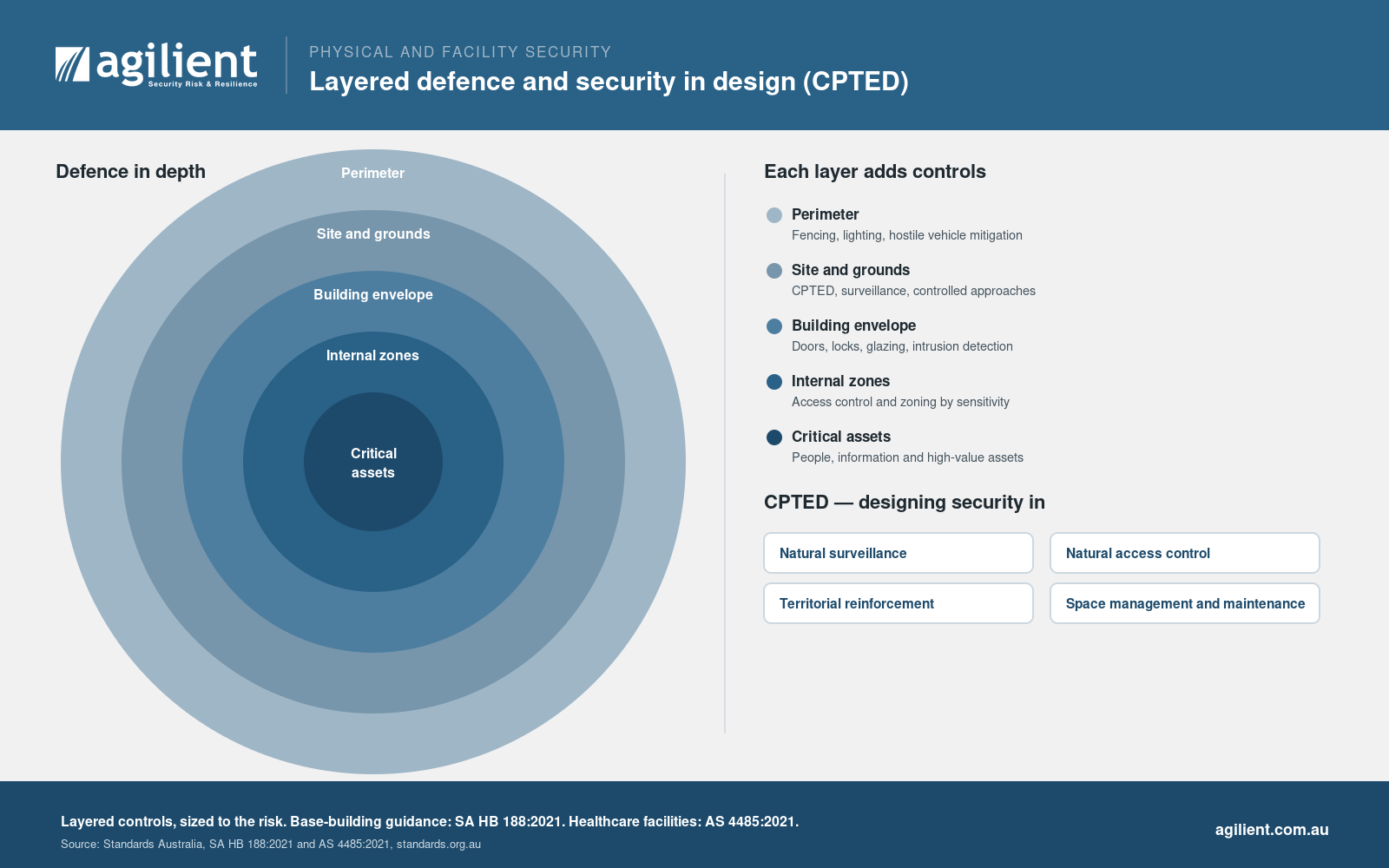
Defence in depth arranges controls in concentric layers, from the perimeter inward, so that risk is reduced progressively rather than relying on a single barrier. CPTED, crime prevention through environmental design, designs security into the built environment through four principles: natural surveillance, natural access control, territorial reinforcement, and space management and maintenance.
Designing security at the planning stage is cheaper and more effective than retrofitting it later, which is why physical security should be integrated while a site or building is still on the drawing board.
The controls
Access control, perimeter and electronic security
The practical controls span several disciplines, each specified to the risk rather than to a product catalogue.
- Perimeter protection. Fencing, lighting, landscaping and, where vehicles are a threat, hostile vehicle mitigation.
- Access control. Controlling who can enter which areas, and zoning the site by sensitivity so that access matches need.
- Electronic security. CCTV, intrusion detection and alarms, and the wider electronic security systems that detect and record activity. For ageing systems, the CCTV upgrade guide covers replacement options and analogue to IP migration. Sector guides cover CCTV for childcare centres, schools, universities, aged care, hospitals and health facilities, councils, stadiums and venues, racing and critical infrastructure.
- Detection and response. The procedures and people who turn a detected event into a timely response.
Security incident response
Responding to a security incident
Physical measures reduce the likelihood of a hostile act, but an organisation also needs a planned response to incidents that can still occur, such as an active armed offender, an intruder, or a bomb threat. A clear response sets out how staff recognise a threat, take protective action and work with police, and how the incident is reported and managed.
For public-facing and crowded sites, the Australian reference point is the Active Armed Offender Guidelines for Crowded Places, developed by the Australia and New Zealand Counter-Terrorism Committee and published through the national crowded places resources.4 The guidance applies a prevent, prepare, respond and recover approach that organisations can adapt to their own sites.
A security incident can escalate beyond the immediate response. When it does, it is taken up by the crisis management team, and the response itself should be practised through the exercising and testing programme, so that people know what to do before an incident occurs.
The bigger picture
How physical security fits the wider framework program
Physical security is one layer of a wider program. The controls an organisation needs are set by its security risk assessment, which decides which physical measures the risk justifies. In government, physical security is a domain of the PSPF. For critical infrastructure, it is one of the hazard vectors a SOCI Act risk-management program must address.
Treating physical security as part of the framework program, rather than a standalone fit-out, keeps the controls proportionate and defensible.
How we help
How Agilient supports physical and facility security
Agilient assesses and designs physical security to mitigate the risk, independent of any product or installer. The work spans government, healthcare, aviation, defence and critical infrastructure.
Physical security assessments
A risk-based review of a site or building and its controls.
Security in design and CPTED
Designing security into new sites and refurbishments.
Access control design
Zoning and access control matched to sensitivity and need.
CCTV and surveillance design
Camera and detection coverage specified for the risk.
Perimeter and HVM
Perimeter protection and hostile vehicle mitigation.
Security plans and documentation
Plans and procedures that evidence the controls in place.
Agilient works across Sydney, Melbourne, Brisbane, Adelaide, Canberra and regional Australia.
Get your physical security designed for the risk
A physical security assessment establishes which controls your site actually needs and in what order before any equipment spending.
Arrange a physical security assessmentor read about the service
FAQs
Frequently asked questions
What is physical and facility security?
What standards apply to physical security in Australia?
What is CPTED?
What is defence in depth?
How do I know which controls I need?
How should an organisation prepare for an active armed offender?

References
- Standards Australia, SA HB 188:2021 Base-building physical security handbook, standards.org.au
- Standards Australia, AS 4485.1:2021 and AS 4485.2:2021 Security for healthcare facilities, standards.org.au
- Standards Australia, AS ISO 31000:2018 Risk management — Guidelines, standards.org.au
- Australia and New Zealand Counter-Terrorism Committee, Active Armed Offender Guidelines for Crowded Places, nationalsecurity.gov.au