

Exercising and testing are the discipline that proves a response plan works before a real disruption tests it. The same method validates business continuity, crisis, emergency, and security incident response plans, so that an organisation identifies its gaps in a controlled exercise rather than during the event itself.
Overview
What is exercising and testing?
Exercising is the structured rehearsal of a plan under realistic conditions to confirm that people, procedures and systems perform as intended. Testing is the narrower act of checking that a specific capability, such as an information and communications technology recovery process, meets a defined requirement. An exercising and testing program brings the two together and repeats them, so readiness is maintained rather than assumed.
The Australian and international reference point is ISO 22398:2013, Societal security — Guidelines for exercises, which sets out good practice for planning, conducting and improving exercises and exercise programs.¹ Its central value is that one method serves every plan type. A tabletop exercise can validate a business continuity plan in the morning and a crisis management plan in the afternoon, because both rest on the same questions: do the right people know their roles, are the decisions sound, and does the plan hold under pressure.
The case for exercising
Why do untested plans fail?
A plan that has never been exercised is a set of assumptions written down. The document may read well, yet the first time it is used under stress is the worst time to discover that a call tree is out of date, that two managers believe the other is in charge, or that a recovery step depends on a system that is itself offline. Exercising and testing surfaces these faults while the stakes are low, and they can be fixed.
Regulators and standards now treat exercising as a requirement rather than an option. ISO 22301 expects business continuity arrangements to be exercised and validated; the SOCI Act critical infrastructure risk management rules require plans to be tested; and APRA CPS 230 requires regulated entities to test their business continuity and operational risk arrangements through scenario analysis. The common message is that an unexercised plan does not demonstrate capability.
Types of exercise
What are the main types of exercise?
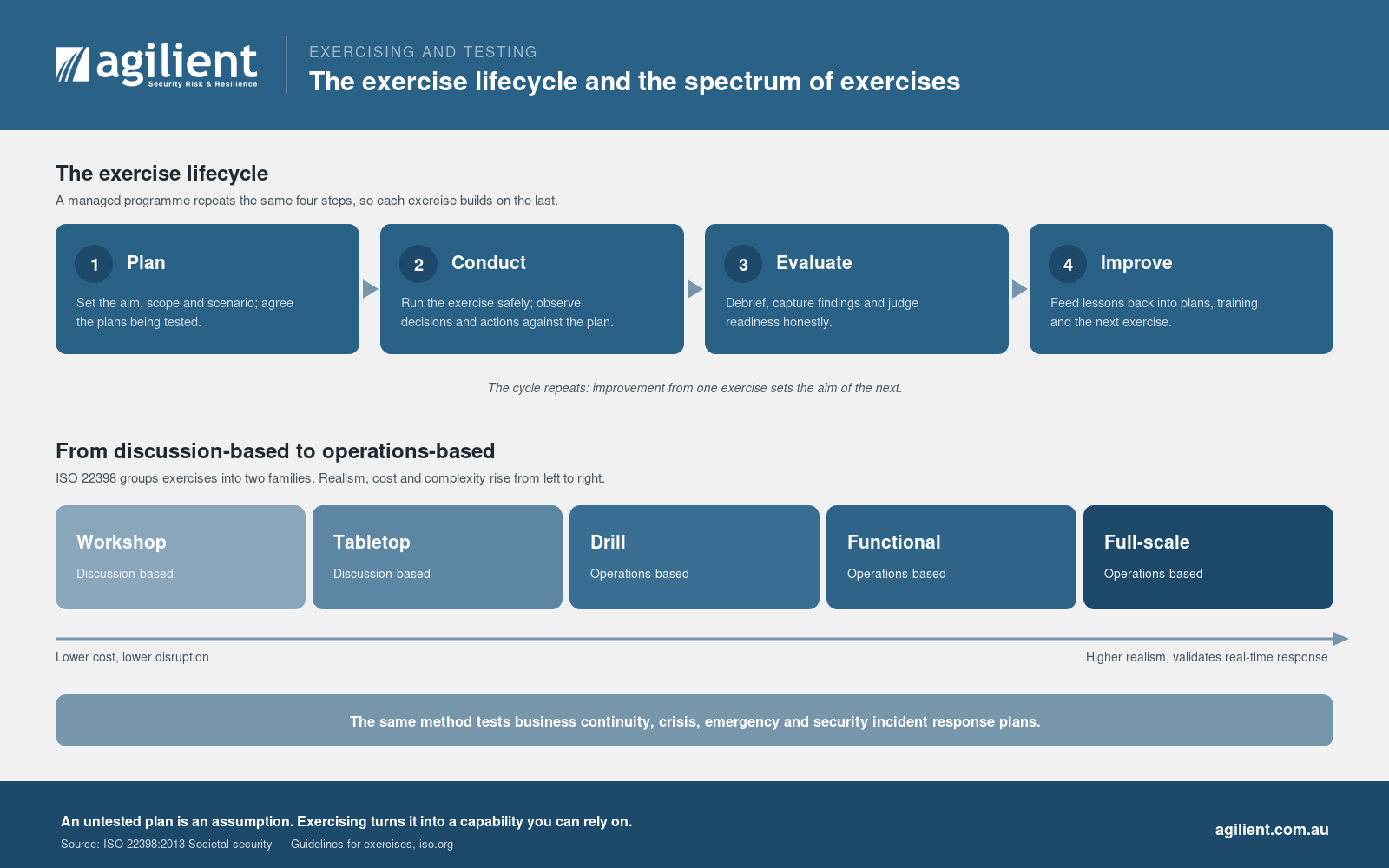
ISO 22398 groups exercises into two families. Discussion-based exercises talk through a scenario in a low-pressure setting, while operations-based exercises put people and systems into action. Realism, cost and disruption rise across the range, so a program usually starts with the simpler forms and works up.
Workshop
A facilitated discussion that builds shared understanding of a plan and its triggers. Discussion-based.
Tabletop exercise
Key people work through a scenario around a table, testing decisions and roles without activating systems. Discussion-based.
Drill and functional
A single capability or function is activated and runs in near real time, such as an evacuation or recovery process. Operations-based.
Full-scale
A live, multi-team exercise that simulates a real event end-to-end. The most realistic and the most demanding. Operations-based.
Tabletop exercises
How do you run a tabletop exercise?
A tabletop exercise is the most common way to test a plan and the people behind it. Decision-makers sit together and work through a realistic scenario that unfolds in stages, without activating systems or moving people. It is low cost and low disruption, and it exposes gaps in roles, authority, information flow and communication that a document review will not find.
- Set the objectives. Decide what the exercise must test, for example escalation to the crisis team, a recovery time objective, or media handling, and keep it to three or four objectives.
- Build a credible scenario. Base it on the organisation’s own risk assessment, such as a site outage, a cyber incident affecting operations, a severe weather event or an active threat, and script injects that raise the pressure over time.
- Choose the participants. Include the people who would actually make the decisions, along with their alternates, and brief them on the ground rules but not the scenario.
- Facilitate, do not lecture. An independent facilitator keeps the discussion moving, asks the uncomfortable questions and stops the group solving the problem in theory rather than in role.
- Capture and act on lessons. Record decisions and gaps as they arise, hold a short hot debrief, then issue a report with owners and dates for each improvement.
Most tabletop exercises run for two to four hours. They work well as the first step in an annual program, before moving to functional or full-scale exercises, and they are a practical way to evidence testing for ISO 22301, the SOCI Act and board assurance. Agilient facilitates tabletop exercises for crisis management and business continuity teams across government and industry.
Business continuity
Exercising business continuity plans
A business continuity exercise checks whether an organisation can keep its critical activities running or recover them within the agreed timeframes in the event of a disruption. Useful scenarios include the loss of a primary site, the failure of a key supplier, and an extended technology outage. The exercise should test the recovery time objectives set in the business impact analysis, not just the plan’s existence. Exercising is a core part of the management system described on the business continuity and ICT resilience pillar.
Crisis management
Exercising crisis management plans
A crisis simulation places the crisis management team in a fast-moving, ambiguous scenario to test decision-making, delegation, and communication under pressure. The aim is not to follow a script but to rehearse judgment when information is incomplete and the situation is changing. Exercising the team and the plan turns a crisis framework into a capability, as set out in the crisis management pillar.
Emergency management
Exercising emergency and evacuation plans
Emergency exercises rehearse the immediate, life-safety response to a facility emergency, such as a fire, an evacuation or a lockdown. In Australia, these are shaped by AS 3745, which expects the emergency control organisation and its wardens to practise the emergency response procedures so that occupants can be moved to safety quickly. An emergency drill is one kind of exercise within the wider program. The facility side is covered on the emergency management pillar.
Security incident response
Exercising security incident response
Security incidents such as an active armed offender, an intruder, or a bomb threat again demand a different response, one that must be practised before it is needed. Exercising these responses tests how staff recognise a threat, take protective action and work with police, and how a security incident is escalated to the crisis management team if it grows beyond the immediate response. The physical and security incident response measures are covered on the physical and facility security pillar.
The program
How do you run an exercise program?
A single exercise is useful, but a managed exercising and testing program is what sustains readiness. ISO 22398 frames it as a repeating cycle, so each exercise builds on the findings of the last rather than starting again.
Plan
Set the aim, scope and scenario, and agree which plans are being tested.
Conduct
Run the exercise safely and observe decisions and actions against the plan.
Evaluate
Debrief, capture findings and judge readiness honestly.
Improve
Feed lessons back into the plans, training and the next exercise.
Repeat
Schedule the next exercise to maintain the capability over time.
Annual exercise programs
Many organisations now commit to an annual exercise program rather than a one-off test. A typical program runs two to four exercises a year, moves from discussion-based tabletop sessions to more demanding scenarios, and ends each session with a short lessons-learned report so that improvements are tested in the next exercise. Over time the program builds a record of how capability has matured, which is useful evidence for boards, regulators and auditors. Business continuity exercises follow ISO 22301:2019 and crisis exercises follow ISO 22361:2022. Agilient’s programs can be supported by Resix, its resilience exercise platform.
Examples include a multi-year crisis management exercise program for a Commonwealth agency, a continuity and disaster recovery exercise series for a Commonwealth agency and scenario-based continuity exercises for a community services organisation.
Exercising also supports wider obligations. Testing a critical infrastructure risk management plan is part of meeting the critical infrastructure and SOCI Act requirements, scenario testing supports the financial services and APRA obligations under CPS 230, and regular testing contributes to the maturity uplift expected under the Protective Security Policy Framework.
How Agilient supports you
How Agilient supports exercising and testing
Agilient designs and facilitates exercises across the full range, from a focused tabletop session for a single plan to a multi-team crisis simulation. Each exercise is built around a realistic scenario for the organisation and its sector, run by an independent facilitator, and followed by a clear evaluation that records findings and practical improvements. The work connects to the broader resilience services so that exercising and testing is part of a maintained program rather than a one-off event.
Test your plans before an event does
A well-run exercise shows where a plan is strong and where it needs work, while the stakes are still low. Agilient designs and facilitates business continuity, crisis, emergency and security exercises for organisations across Australia.
FAQs
Frequently asked questions
What is the difference between exercising and testing?
What is a tabletop exercise?
How often should a business continuity plan be exercised?
Which standard covers exercising?
Can one exercise test more than one plan?

References
- International Organization for Standardization, ISO 22398:2013 Societal security — Guidelines for exercises, iso.org
- International Organization for Standardization, ISO 22301:2019 Security and resilience — Business continuity management systems — Requirements, iso.org
- Australian Prudential Regulation Authority, Prudential Standard CPS 230 Operational Risk Management, apra.gov.au
- Standards Australia, AS 3745-2010 Planning for emergencies in facilities, standards.org.au