

Emergency management is how a facility prepares for and responds to events that threaten life safety, from fire and evacuation to a security incident. In Australia it is built on AS 3745-2010, which sets out the emergency planning committee, the emergency control organisation and the warden structure. Exercising, guided by ISO 22398, is how those plans are tested before they are needed.
For facility and building managers, the obligation is practical: a current emergency plan, a trained control organisation, and exercises that prove the plan works. This page explains what AS 3745 requires, how the warden structure is organised, and how exercising connects emergency, continuity and crisis plans.
Overview
What is emergency management in a facility?
Emergency management in a facility is the planning and response that keeps occupants safe during an emergency, and gets them out or to safety in good order. It covers the procedures, the people who run them, and the training and exercises that keep them current.
It is distinct from, but connected to, business continuity and crisis management. Emergency management protects life safety in the first minutes; continuity keeps the organisation operating afterwards; crisis management leads the strategic response when an incident is serious or prolonged.
The standard
AS 3745-2010 and the emergency control organisation
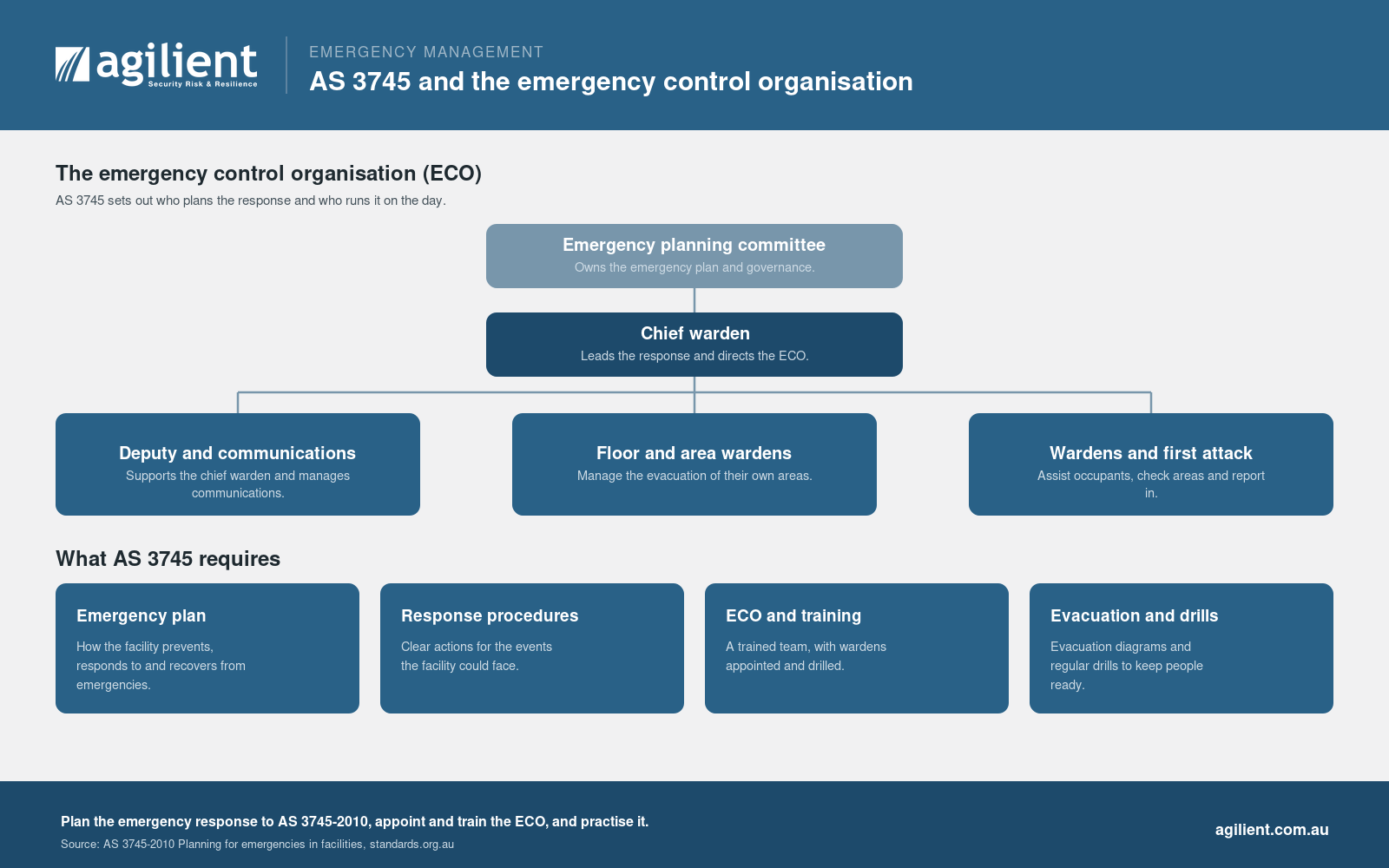
AS 3745-2010, Planning for emergencies in facilities, is the Australian standard for emergency planning in facilities. It sets out the role of the emergency planning committee, which owns the emergency plan, and the emergency control organisation (ECO), the trained team that runs the response on the day. The ECO is led by the chief warden and supported by floor and area wardens, who manage evacuations in their areas.
The standard sets minimum requirements for the emergency plan, the response procedures, the establishment and training of the ECO, and the testing and validation of the procedures.
Plans and people
Emergency plans, evacuation and wardens
The emergency plan documents how the facility identifies, responds to and recovers from emergencies, and how occupants are evacuated. It is supported by emergency response procedures for the specific events the facility could face and by the warden structure, which places trained personnel in place to direct occupants.
Plans and wardens are only as good as the training behind them. AS 3745 requires that the ECO be trained and the procedures be validated, which is where exercising comes in.
Exercising
Practising the emergency response
An emergency plan is only as good as the response it produces, so the emergency control organisation and its wardens practise the procedures regularly. AS 3745 requires evacuation exercises to be held so that occupants and wardens know what to do and the arrangements remain current. An emergency drill is one kind of exercise. The wider discipline of testing business continuity, crisis and security plans, and the standard ISO 22398:2013 that guides it, is covered on the exercising and testing pillar.
How we help
How Agilient supports emergency management
Agilient develops facility emergency plans in accordance with AS 3745, trains the people who run them, and designs and facilitates the exercises that test them. The work spans government, healthcare, aviation, public venues and critical infrastructure.
Emergency plans
Facility emergency plans and response procedures in accordance with AS 3745.
ECO and warden training
Establishing and training the emergency control organisation.
Evacuation procedures
Evacuation planning and diagrams for the facility.
Exercise design and facilitation
Tabletop and operational exercises to ISO 22398.
Validation and debriefs
Evaluating exercises and capturing the improvements.
Plan reviews
Keeping emergency plans and training current.
Agilient works across Sydney, Melbourne, Brisbane, Adelaide, Canberra and regional Australia.
Test your emergency plans before they are needed
A well-run exercise identifies gaps in your emergency, continuity, and crisis plans while it is still safe to fix them.
Talk to us about emergency management and exercisingor read about the service
FAQs
Frequently asked questions
What is AS 3745?
What is the emergency control organisation?
What is the difference between emergency management and crisis management?
Are emergency drills a type of exercise?
How often should emergency plans be exercised?

References
- Standards Australia, AS 3745-2010 Planning for emergencies in facilities, standards.org.au
- ISO, ISO 22398:2013 Societal security — Guidelines for exercises, iso.org