
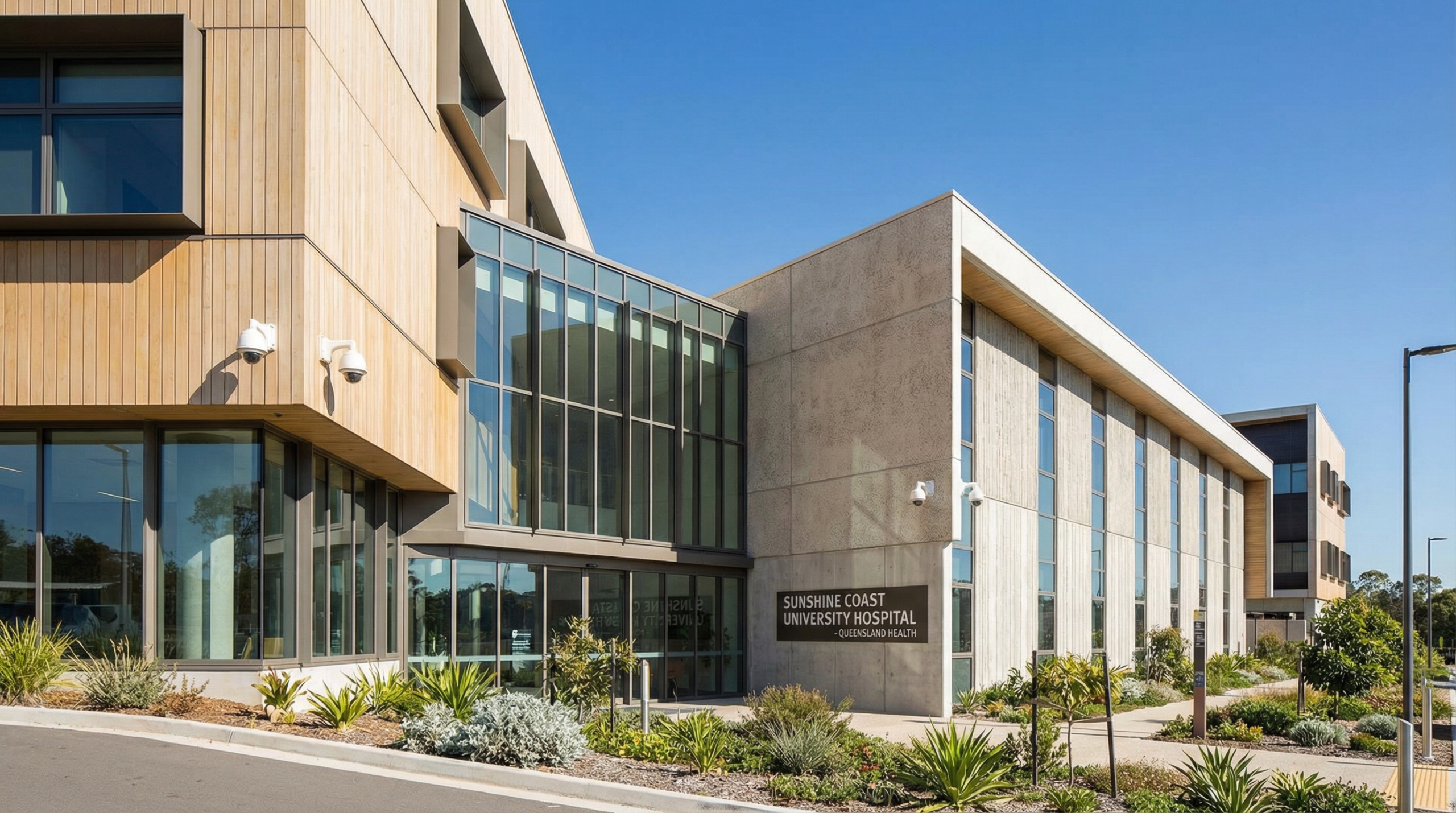
Hospital and healthcare security is the practice of protecting patients, staff, visitors and assets across health facilities, from emergency departments and mental health units to pharmacies and records. In Australia it is guided by AS 4485 Security for healthcare facilities, and its dominant operational risk is occupational violence and aggression. This page explains how healthcare facilities are secured, the standards that apply, and how a structured approach keeps an open, caring environment safe.
What guides hospital and healthcare security in Australia?
Healthcare facility security is guided by AS 4485 Security for healthcare facilities, revised in 2021 and published in two parts: AS 4485.1:2021 General requirements and AS 4485.2:2021 Procedures guide. Together they set out the policy, principles and procedures for protecting people, premises, medicines and information in health settings.
The standard is supported by broader design guidance, including the Australasian Health Facility Guidelines, which address security among facility design considerations. Applied well, these references help a hospital stay open and welcoming while keeping sensitive areas secure.
How is security zoning used in hospitals?
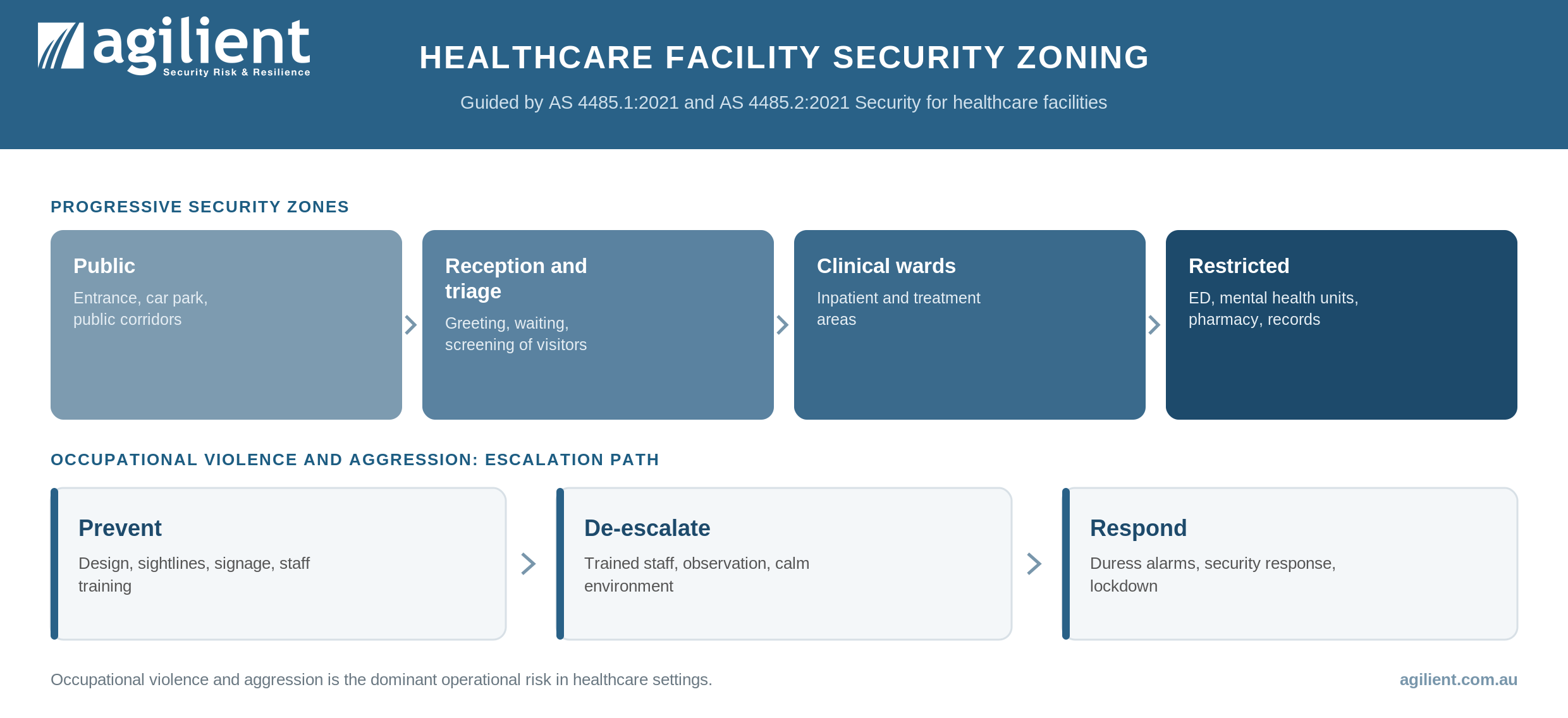
Security zoning manages the move from fully public areas to highly restricted ones. A typical progression runs from public spaces such as entrances and car parks, through reception and triage, into clinical wards, and then to restricted areas such as the emergency department, mental health units, pharmacy and records.
Each zone applies controls proportionate to its sensitivity, including access control, surveillance and clear sightlines. Zoning lets a facility welcome the public at the front while protecting patients, staff and controlled substances deeper inside.
How is occupational violence and aggression managed?
Occupational violence and aggression is the dominant operational risk in healthcare, particularly in emergency departments and mental health units. It is managed along an escalation path: prevention through design, sightlines, signage and staff training; de-escalation by trained staff in a calm, well-observed environment; and response through duress alarms, security support and, where needed, lockdown.
Designing for this risk is a balance. The environment must remain therapeutic and accessible while giving staff the tools and layout they need to stay safe.
What role do duress, access control and CCTV play?
Electronic controls underpin healthcare security. Duress alarms let staff call for help discreetly, access control restricts movement into clinical and restricted zones, and CCTV supports deterrence, monitoring and post-incident review. These systems work best when they follow from a risk assessment rather than being added piecemeal.
Agilient advises on electronic security and CCTV design for healthcare settings, specified to the facility’s zones and risks rather than to a particular product.
How does Agilient support healthcare facilities?
Agilient is an independent, vendor neutral security and risk consultancy. For health clients, work usually begins with a security risk assessment that maps the facility’s assets, threats and risks, with particular attention to occupational violence, and identifies proportionate controls aligned with AS 4485.
From there, Agilient supports building and facility security design, security audits, and electronic security and CCTV advice. The method is set out on the security risk management pillar, and the built-environment controls on the physical and facility security pillar.
Make your health facility safer for patients and staff
Speak with Agilient about hospital and healthcare security, from AS 4485 and zoning to managing occupational violence. The usual first step is a security risk assessment of your facility.
Request a security risk assessment
or read about the service
Frequently asked questions
What does hospital and healthcare security cover?
What is AS 4485?
Why is occupational violence such a focus in healthcare?
How does security zoning work in a hospital?
Does Agilient design CCTV and duress systems for hospitals?
- Standards Australia, AS 4485.1:2021 and AS 4485.2:2021 Security for healthcare facilities, standards.org.au
- Australasian Health Infrastructure Alliance, Australasian Health Facility Guidelines, healthfacilityguidelines.com.au