

Aged care security is the protection of residents, staff and visitors in residential aged care, framed as part of the safety and quality the sector is required to deliver. Under the Aged Care Act 2024 and the strengthened Aged Care Quality Standards, in effect from 01/11/2025, providers must manage risks including occupational violence, wandering and elopement, and serious incidents. This page explains what aged care security involves and how a structured approach supports compliance and resident wellbeing.
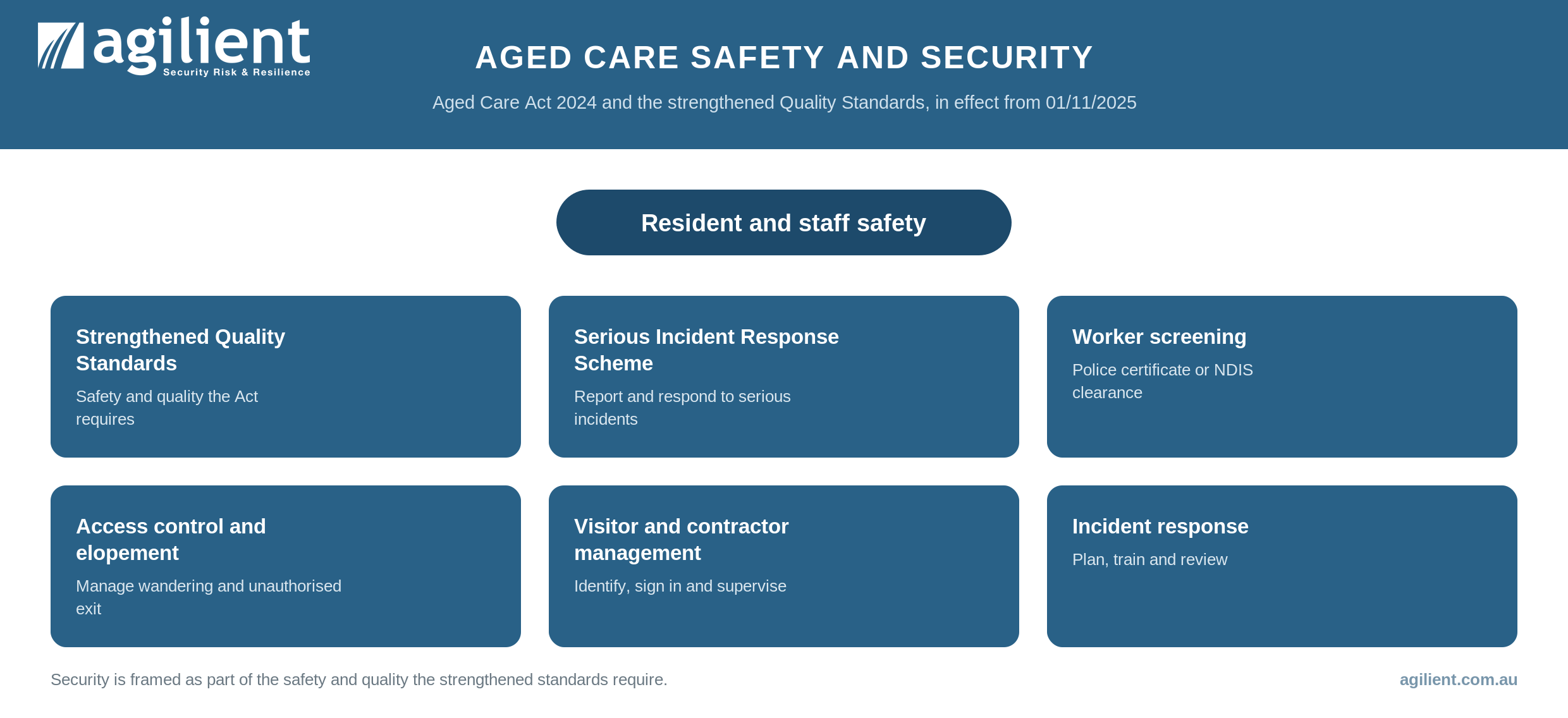
What governs safety and security in aged care?
Residential aged care is governed by the Aged Care Act 2024 and the strengthened Aged Care Quality Standards, which took effect on 01/11/2025, administered by the Aged Care Quality and Safety Commission. The standards place the safety, rights and wellbeing of older people at the centre of how a service operates.
Security in aged care is best understood as one part of that safety and quality obligation. Rather than a separate compliance silo, it supports the outcomes the standards require for residents and staff.
How are resident and staff safety and occupational violence managed?
Day to day, aged care security focuses on the safety of residents and staff. Occupational violence can arise in care interactions, and it is managed through environment design, staff training, observation and clear response procedures.
Good security here is unobtrusive. It protects people without making a home feel institutional, which matters for resident dignity and wellbeing.
How is wandering and elopement risk controlled?
Wandering and unauthorised exit, sometimes called elopement, is a particular risk where residents live with dementia. It is managed through considered access control, layout and monitoring that keep residents safe while preserving their freedom of movement within safe areas.
The aim is a balance: reduce the risk of a resident leaving unsafely, without confining people or compromising amenity.
How do the SIRS and worker screening apply?
The Serious Incident Response Scheme (SIRS) requires providers to identify, respond to and report serious incidents, and the Aged Care Act 2024 introduced changes to reportable incidents from 01/11/2025. A clear incident response capability, including planning, training and review, is central to meeting these obligations.
Worker screening is also part of the safeguards. From 01/11/2025, aged care workers and responsible persons must hold a valid police certificate or NDIS worker screening clearance, supporting a safe workforce around vulnerable residents.
How does Agilient support aged care providers?
Agilient is an independent, vendor neutral security and risk consultancy. For aged care providers, work usually starts with a security risk assessment that identifies the risks specific to a service, from occupational violence and elopement to visitor management, and sets out proportionate controls.
From there, Agilient supports building and facility security design and security audits that test readiness against the strengthened standards. The aged care CCTV guide covers cameras, consent and privacy in residential aged care. The underlying method is set out on the security risk management pillar, and the built-environment controls on the physical and facility security pillar.
Build security into your aged care safety and quality
Speak with Agilient about aged care security under the Aged Care Act 2024 and the strengthened standards, from occupational violence and elopement to incident response. The usual first step is a security risk assessment of your service.
Request a security risk assessment
or read about the service
Frequently asked questions
What does aged care security involve?
What changed on 1 November 2025?
What is the SIRS?
What are the worker screening requirements?
How does Agilient help with aged care security?
- Aged Care Quality and Safety Commission, Aged Care Act 2024, strengthened Quality Standards and the SIRS, agedcarequality.gov.au
- Australian Government Department of Health, Disability and Ageing, Aged care worker screening, health.gov.au