
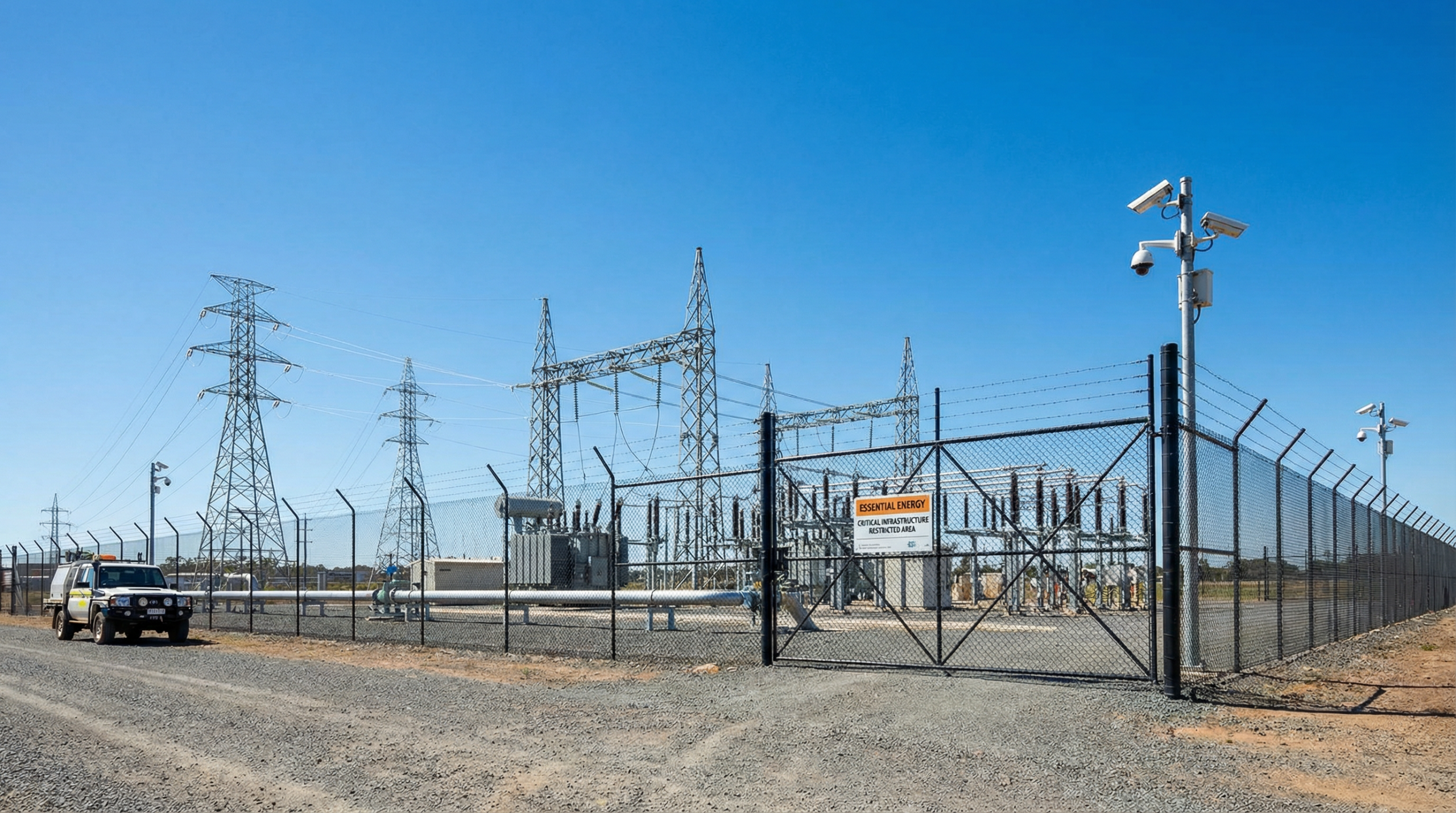
The Security of Critical Infrastructure Act 2018, the SOCI Act, places security obligations on the operators of Australia’s most important assets. Its central requirement is the Critical Infrastructure Risk Management Program, a CIRMP, under which a responsible entity must identify and manage risk across four hazard vectors, report annually to the regulator, and have the program approved by its board. The regime was expanded through reforms in 2024 and 2025.
For operators of critical infrastructure assets, their boards and risk leads, the SOCI Act is neither optional nor static. This page explains what the Act requires, who it applies to, how the CIRMP works, the four hazard vectors it must address, the annual reporting and board accountability that accompany it, and what changed in the recent reforms.
Overview
What is the SOCI Act?
The Security of Critical Infrastructure Act 2018 is the Commonwealth law that manages national security risks to critical infrastructure. It imposes obligations on responsible entities for assets in defined critical infrastructure sectors, with the aim of protecting those assets from cyber, physical, personnel and supply chain hazards. It is administered by the Cyber and Infrastructure Security Centre.
The Act has grown considerably since 2018, first through reforms that introduced positive security obligations, including the risk-management program, and again through the 2024 and 2025 reforms described below.
Scope
Who is a responsible entity, and which assets are covered?
The Act applies to responsible entities for critical infrastructure assets across defined sectors, which include energy, communications, data storage or processing, financial services and markets, water and sewerage, health care and medical, food and grocery, transport, higher education and research, the space technology sector, and the defence industry.
Not every obligation applies to every asset. The CIRMP obligation, in particular, is switched on for specified asset classes under the CIRMP Rules, so the first step for any operator is to confirm whether its assets are captured and which obligations apply.
The program
The Critical Infrastructure Risk Management Program (CIRMP)
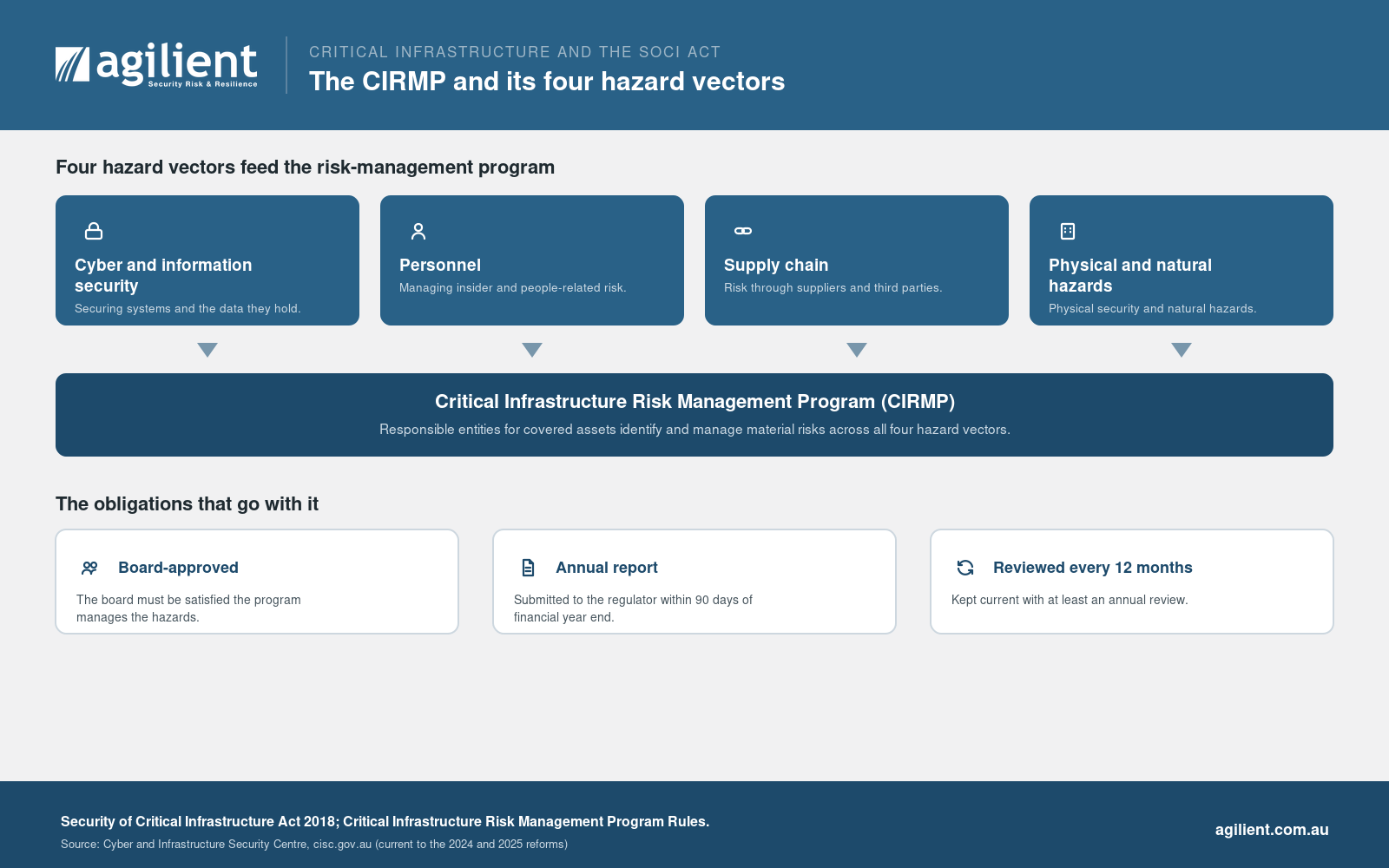
Where the obligation applies, a responsible entity must have, and comply with, a CIRMP. The program must identify each hazard that could have a relevant impact on the asset and, so far as is reasonably practicable, minimise or eliminate the risk of that hazard, then mitigate the impact of any incident that does occur. It must address four hazard vectors:
- Cyber and information security hazards.
- Personnel hazards.
- Supply chain hazards. Covered in the supply chain security pillar.
- Physical and natural hazards.
The program is not a one-off document. It must be reviewed regularly and kept current as the asset and its risks change.
A critical infrastructure risk management plan must be reviewed and tested, not just written. Testing the plan against realistic scenarios is covered on the exercising and testing pillar.
Reporting
Annual reporting and board accountability
A responsible entity must give an annual report on its CIRMP to the relevant regulator within 90 days of the end of the Australian financial year. The report must be approved by the entity’s board or governing body, thereby making the board directly accountable for the program’s adequacy. The CIRMP itself must be reviewed at least once every 12 months.
Recent changes
What changed with the 2024 to 2026 reforms?
The regime was expanded by the Security of Critical Infrastructure and Other Legislation Amendment (Enhanced Response and Prevention) Act 2024. Most of its provisions commenced on 20/12/2024, with the telecommunications provisions commencing on 04/04/2025.
- Data storage systems. The Act was clarified to cover the protection of certain data storage systems that hold business-critical data.
- All-hazards response powers. New powers allow government to direct action and information gathering to manage the impact of an all-hazards incident on critical infrastructure.
- Risk-management program directions. The regulator can now issue a written direction to a responsible entity to address seriously deficient parts of its risk-management program.
- Telecommunications security. The Telecommunications Security and Risk Management Program Rules 2025 commenced on 04/04/2025 for carrier and carriage service provider assets, bringing telecommunications into the framework.
An independent review of the SOCI Act was delivered on 31/01/2026, and further consultation on the regime is ongoing, so operators should expect the obligations to continue evolving.
Enhanced CIRMP Rules (2026). The Security of Critical Infrastructure Legislation Amendment (Enhanced Critical Infrastructure Risk Management Program) Rules 2026 (LIN 26/075) commenced on 10/06/2026. They add enhanced requirements across the cyber, personnel, supply chain and physical hazards for critical broadcasting, domain name system, electricity, energy market operator, freight infrastructure, freight services, gas, liquid fuel and water assets. For physical security, the new section 11A requires central management of physical security and natural hazards, access to critical components restricted to critical workers or accompanied visitors, continuous monitoring of critical components, and separate business hours and out-of-hours measures. The critical infrastructure CCTV guide explains what continuous monitoring means for video surveillance. Critical workers must be assessed as suitable through an AusCheck background check or hold a relevant security clearance. For assets that were already critical infrastructure assets, most enhanced requirements apply from 10/06/2028, and some, including additional material risks and personnel access management, from 10/06/2027. The CIRMP physical security playbook sets out how to implement the physical requirements, the CIRMP personnel security playbook covers critical workers and AusCheck background checks, and the enhanced CIRMP Rules operator guide covers the full set of changes.
The bigger picture
How SOCI relates to the PSPF and to business continuity
The SOCI Act does not sit in isolation. Its risk-management approach mirrors the security risk management discipline that underpins every framework on this hub, and an operator that also handles government information may have PSPF obligations alongside it. Where artificial intelligence is embedded in an operational process, it forms part of the same hazard picture rather than sitting outside it, which is covered on the AI governance pillar.
Because the four hazard vectors include physical and natural hazards, a CIRMP overlaps heavily with physical and facility security and with business continuity and the wider resilience disciplines.
How we help
How Agilient supports SOCI and CIRMP compliance
Where a responsible entity is also subject to foreign ownership, control or influence conditions arising from foreign investment, Agilient extends the same risk and audit discipline to FIRB and foreign investment security compliance.
Agilient helps responsible entities understand their SOCI obligations and build a CIRMP that withstands board scrutiny and regulatory review. The work is independent and spans the critical infrastructure sectors.
CIRMP development
A risk-management program built to the CIRMP Rules and your assets.
Critical infrastructure risk assessment
Assessing risk across all four hazard vectors.
All-hazards gap assessment
Where your current program meets the obligation, and where it does not.
Annual reporting support
Help prepare the board-approved annual CIRMP report.
Board and governance advisory
Briefing boards on their accountability under the Act.
CIRMP review and uplift
Keeping the program current through the annual review.
Agilient works across Sydney, Melbourne, Brisbane, Adelaide, Canberra and regional Australia.
Get your CIRMP right
Whether you are confirming whether the SOCI Act applies to your assets or enhancing an existing program, Agilient can help you meet the obligation and satisfy your board.
Discuss a CIRMP or critical infrastructure risk assessmentor read about the service
FAQs
Frequently asked questions
What is the SOCI Act?
What is a CIRMP?
What are the four hazard vectors?
When is the CIRMP annual report due?
What changed in the 2024 to 2026 reforms?

References
- Federal Register of Legislation, Security of Critical Infrastructure Act 2018, legislation.gov.au
- Cyber and Infrastructure Security Centre, Critical Infrastructure Risk Management Program, cisc.gov.au
- Cyber and Infrastructure Security Centre, Cyber Security Legislative Reforms — Enhanced Response and Prevention Act 2024, cisc.gov.au