

Business continuity management is how an organisation keeps its most important activities running through a disruption and restores the rest in a controlled, prioritised way. In Australia, it is built on ISO 22301:2019, the business continuity management system standard, with ISO/IEC 27031:2025 making the technology on which those activities depend recoverable. The starting point is a business impact analysis that sets the recovery objectives.
For business continuity and resilience leads, the value is a plan that actually works on the day, not a document that satisfies an audit. This page explains the management-system approach, the recovery objectives produced by a business impact analysis, how ICT readiness fits, and how continuity meets SOCI and APRA obligations.
Overview
What is business continuity management?
Business continuity management is the discipline of identifying the activities an organisation cannot do without, determining how quickly they must be restored after a disruption, and putting arrangements in place to keep them running or recover them in time. It is concerned with outcomes and with keeping critical services available, rather than with any single cause of disruption.
When done well, it is a continuing management system rather than a binder on a shelf: it is governed, resourced, tested, and improved over time, so that the response is current when needed.
What is a business continuity plan?
A business continuity plan is the documented set of procedures an organisation uses to keep delivering its most important activities during a disruption and to recover them afterwards. It records which activities matter most, how quickly each must be restored, the resources and workarounds required, and who does what when an incident occurs.
A sound plan is built on a business impact analysis, which sets the recovery time and recovery point objectives the plan is designed to meet. It covers response and recovery strategies, the roles and authority of the people involved, internal and external communications, and the dependencies, such as technology, suppliers and premises, that the critical activities rely on.
A plan is only as good as its last test. Exercising the plan, under ISO 22398, confirms it works before a real event does. A documented plan that has never been exercised is an assumption, not a capability.
The standard
ISO 22301:2019 and the management-system approach
ISO 22301:2019, Security and resilience — Business continuity management systems — Requirements, is the international standard for business continuity that organisations certify against. It sets out a management system: leadership and policy, a business impact analysis and risk assessment, continuity strategies and solutions, documented plans, exercising, and continual improvement.
The standard does not prescribe a single plan. It requires an organisation to understand its own priorities and build proportionate arrangements around them, thereby keeping continuity tied to what the business actually needs.
The management-system approach also expects the arrangements to be exercised and validated at planned intervals, so the plan is proven rather than assumed. This is covered on the exercising and testing pillar.
The objectives
The business impact analysis, RTO and RPO
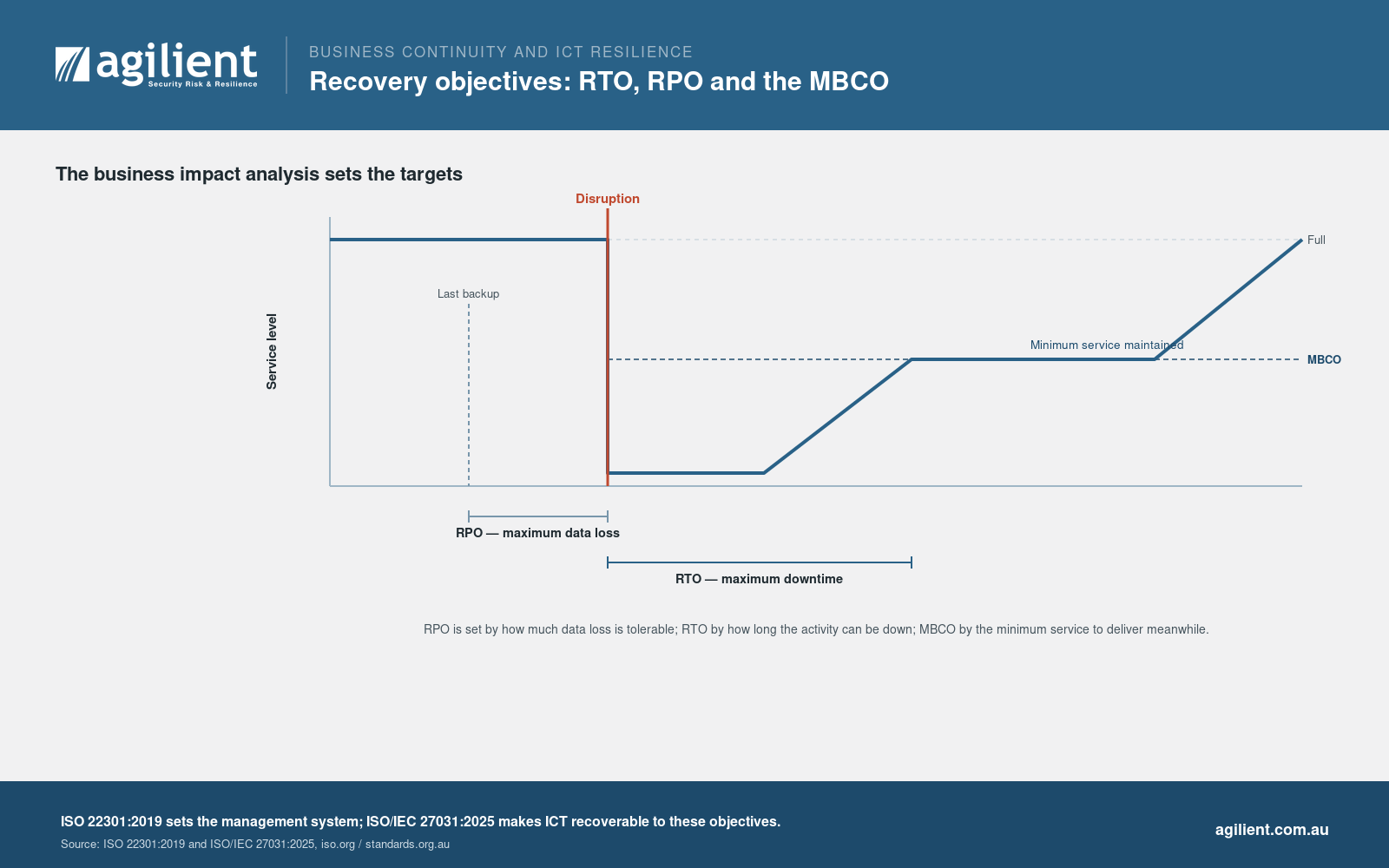
The business impact analysis (BIA) is the foundation. It identifies the most important activities and sets three objectives for each: the recovery time objective (RTO), the longest acceptable time an activity can be down; the recovery point objective (RPO), the most data loss that is tolerable; and the minimum business continuity objective (MBCO), the minimum level of service that must be maintained during a disruption.
These objectives drive everything else. They decide how resilient the supporting technology must be, how much standby capacity is justified, and how quickly recovery must occur.
ICT readiness
ICT readiness and ISO/IEC 27031:2025
Most critical activities now depend on technology, so business continuity depends on ICT readiness. ISO/IEC 27031:2025, Cybersecurity — Information and communication technology readiness for business continuity, is the current standard for this. It is the second edition, published in 2025, and it replaces the 2011 edition, which used a different title.
The 2025 standard treats ICT readiness as a governance and board concern rather than a purely technical exercise. It provides a framework for making ICT recoverable to the RTO and RPO, as set by the business impact analysis, and for aligning that readiness with business continuity, information security and incident response. IT disaster recovery sits within this discipline; it does not need a separate framework.
Exercising
Exercising and validating the continuity plan
A continuity plan that has never been exercised is a set of assumptions written down. The first real disruption is the worst time to discover that a recovery step depends on a system that is itself offline, or that two managers each believe the other is in charge. Exercising surfaces these faults while the stakes are low, confirming that the plan meets the recovery time objectives set in the business impact analysis and keeping the plan current as the organisation changes.
The range runs from a discussion-based tabletop exercise through to a full-scale test, and a managed programme repeats it to maintain readiness. The method is set out on the exercising and testing pillar.
The bigger picture
How business continuity supports SOCI and APRA obligations
Business continuity is also a compliance building block. For operators of critical infrastructure, continuity is part of managing the all-hazards risk that a SOCI Act risk-management program must address. For APRA-regulated entities, operational resilience and business continuity are central to APRA’s prudential standard CPS 230. In both cases, a credible continuity capability built on ISO 22301 and grounded in security risk management does double duty as evidence of compliance.
How we help
How Agilient supports business continuity
Agilient builds and tests business continuity capability in line with ISO 22301 and ISO/IEC 27031, from analysis through to exercises that prove it. The work spans government, healthcare, aviation, defence and critical infrastructure.
Business impact analysis
Identifying critical activities and setting RTO, RPO and MBCO.
Continuity plans
Practical, prioritised plans built around the recovery objectives.
ICT readiness and IT disaster recovery
Making the technology recoverable in accordance with ISO/IEC 27031:2025.
Management system development
An ISO 22301 business continuity management system.
Exercising and testing
Tabletop and simulation exercises that test the plans.
Review and improvement
Keeping the program current as the organisation changes.
Agilient works across Sydney, Melbourne, Brisbane, Adelaide, Canberra and regional Australia.
Build continuity that holds up when tested
A business impact analysis sets the recovery objectives around which the rest of your continuity program is built. It is the practical first step.
Talk to us about business continuityor read about the service
FAQs
Frequently asked questions
What is ISO 22301?
What are RTO, RPO and MBCO?
What does ISO/IEC 27031:2025 cover?
Is IT disaster recovery the same as business continuity?
Where does business continuity start?
How often should a business continuity plan be exercised?

References
- Standards Australia, ISO 22301:2019 Security and resilience — Business continuity management systems — Requirements, standards.org.au
- ISO, ISO/IEC 27031:2025 Cybersecurity — Information and communication technology readiness for business continuity, iso.org