

In the 2026 risk landscape, a Business Continuity Plan (BCP) left untouched on a shared drive is not an operational safeguard. It is a compliance liability. Too many organisations treat business continuity planning as a static, check-box exercise. They then discover during a live crisis that documented assumptions fall short under real-world pressure. When disruption occurs, response capability depends entirely on an organisation’s history of practical validation. That disruption may take the form of an extreme weather event, a complex technical outage, or a fast-moving crisis driven by the modern outrage economy.
A business continuity plan that is not regularly tested is not a plan. It is simply a document. Determining the correct frequency for business continuity plan testing means moving past arbitrary schedules. The cadence should reflect an organisation’s risk appetite, operational changes, and regulatory requirements.
Key Takeaways:
- No Universal Cadence: The correct testing frequency depends on an organisation’s risk profile, sector regulations, and rate of operational change.
- ISO 22301 Foundations: International standards require testing at planned intervals. An annual test is a baseline, not an operational ceiling.1
- Tiered Testing Methodologies: Tabletop exercises, functional drills, and full simulations each evaluate distinct resilience capabilities and reveal different control gaps.
- Triggered Revalidation: Material changes to infrastructure, personnel, vendor arrangements, or external threats require immediate, off-schedule testing.
- Specialised Resilience Integration: Agilient’s senior consultants design and facilitate objective testing programmes. They deliver these across government, healthcare, and critical infrastructure estates.
Why Testing Frequency Matters More Than Most Organisations Realise
There is a substantial difference between holding a documented plan and maintaining an active operational response capability. When a disruptive incident unfolds, an organisation will not rise to the level of its documentation. It will default to the level of its training.
Many continuity plans are drafted during major project handovers and then archived. Over time, subtle operational adjustments degrade their reliability. Staff move to new roles, system configurations are updated, and external dependencies change. Regular BCP testing assesses these failure points. It reveals hidden gaps before they expand into operational failure.
In the current threat environment, disruptions move faster than traditional recovery windows. A minor functional breakdown or unpatched IT fault can cascade into a reputational issue through public mistrust and digital amplification. Frequent testing strengthens an executive team’s ability to make clear, fast-paced crisis decisions. This protects core assets and institutional legitimacy.
What the Standards Say About BCP Testing
To build a defensible compliance architecture, organisations should align with established national and international frameworks. ISO 22301:2019 is the global benchmark for business continuity management systems and sets clear requirements for exercising and testing. The standard requires organisations to conduct exercises and testing consistent with their business continuity objectives. This testing should occur at planned intervals and when significant operational changes arise.1
In the Australian context, requirements are further refined by specific administrative and legislative mandates. Commonwealth entities are governed by the Public Governance, Performance and Accountability Act 2013 (PGPA Act). The PGPA Act imposes broader risk management and accountability obligations on these entities. It requires them to establish robust internal mechanisms to maintain continuity of critical public operations under stress.2 This governance aligns with the Protective Security Policy Framework (PSPF). The PSPF requires government bodies to actively monitor, test, and attest to the effectiveness of their protective security and continuity arrangements.3
For entities operating within Australia’s critical infrastructure sectors, the Security of Critical Infrastructure Act 2018 (SOCI Act) formalises these protocols. Under the enhanced Critical Infrastructure Risk Management Program (CIRMP) rules, captured entities must mitigate material risks across physical, personnel, cyber, and supply chain domains. This framework requires regular, simulated threat testing. The objective is to provide demonstrable operational assurance to boards, councils, and federal regulators.4
Factors That Should Determine Your Testing Schedule
Relying on a static annual calendar entry can introduce unmanaged risk. BCP scenario testing cadence should be determined dynamically by five core drivers:
- Sector and Regulatory Requirements: Regulated entities in healthcare, banking, or critical infrastructure face stringent testing mandates. Enhanced SOCI Act rules, for example, impose higher penalty regimes on entities that fail to demonstrate verified control effectiveness.4
- Organisational Complexity and Scale: Geographically dispersed facilities and multi-tiered logistics operations require more frequent, segmented testing. The same applies to environments with complex interactions between Information Technology (IT) and Operational Technology (OT).
- Rate of Internal Change: High staff turnover, rapid structural reorganisations, or frequent IT infrastructure upgrades all require immediate validation of response procedures.
- Previous Test Metrics and Gaps: A prior exercise may have revealed deficiencies in communication channels or in the availability of backup systems. The remediation window should close with a dedicated retest.
- Evolving Threat Environment: Human-centric threats are accelerating, including anti-authority movements, sovereign citizens, fixated individuals, and targeted supply chain disruption. Organisations should test non-linear threat vectors regularly to keep pace.5
The Main Types of BCP Testing and When to Use Them
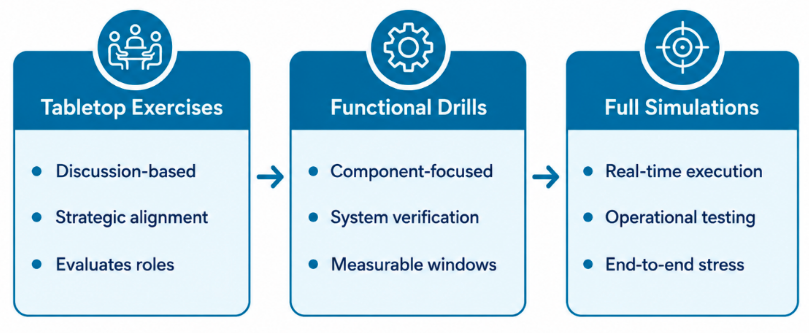
An effective resilience strategy uses a layered mix of exercise types to evaluate response capabilities end-to-end. The diagram below shows how organisations build maturity. They progress from discussion-based sessions to real-time, live operational validations:
Tabletop Exercises: Strategic Alignment
A tabletop exercise is a discussion-based session where key stakeholders work through a simulated scenario. It is an effective method for reviewing roles, refining delegations of authority, and evaluating strategic communication paths. Tabletop exercises also test slow-lane communication protocols. They ensure executives can pause to verify facts before releasing public statements during a hyper-viral incident.5
Functional Drills: System Verification
Functional drills test specific operations, capabilities, or technological systems in isolation. This includes executing an IT Disaster Recovery plan in accordance with ISO 27031 guidelines. The drill measures the actual Recovery Time Objective (RTO) against live data backup restorations.6 Functional drills give quantitative verification that technological assets can support continuity when primary systems fail.
Full Simulations: Operational Assurance
A full simulation replicates a live disruptive incident as closely as possible. It moves personnel, activates secondary command sites, and operates under degraded conditions. Full simulations are logistically demanding, but they deliver genuine operational assurance. They reveal hidden points of failure, such as the psychological impact of extended stress on critical workers. They also create friction when third-party supply chain vendors are forced to resort to manual fallback routines.4
Signs Your Testing Programme Needs a Review
If an organisation displays any of the following indicators, its business continuity testing model may be leaving it exposed:
- Recycled Scenarios: Running the same basic fire drill or localised power-outage scenario year after year fails to stress-test teams against modern, cross-domain threats.
- Untested Architectural Assumptions: Assuming remote connection capacities, secondary vendor speeds, or manual overrides will function as intended without real-world validation.
- Absence of Critical Personnel: Allowing core executive leaders, senior directors, or key stakeholders to delegate their exercise roles to junior staff.
- No Documented Improvement Architecture: Concluding an exercise with an informal debrief rather than an auditable, data-driven report that feeds directly into the corporate risk register.
How Agilient Supports BCP Testing and Exercises
True organisational resilience is built when technical capability aligns with boardroom strategy. Agilient acts as an independent, specialist advisory partner to public- and private-sector clients. Agilient helps clients transform business continuity documentation into a verified, robust capability.
Agilient draws on extensive experience across federal security estates, regional local councils, major utility providers, and acute healthcare networks. Agilient designs tailored, all-hazards exercises that test every security domain. These range from brief tabletop sessions for executive leadership to multi-site, multi-hazard simulations. Agilient’s senior consultants ensure the client’s resilience framework withstands real-world disruptions. Agilient helps clients move past static check-box compliance to a state of defensible operational assurance.
Agilient welcomes the opportunity to discuss how its advisory team can facilitate your next business continuity or crisis management exercise.
References
- International Organization for Standardization, ISO 22301:2019 Security and resilience — Business continuity management systems — Requirements, iso.org/standard/75106.html
- Australian Government, Public Governance, Performance and Accountability Act 2013, legislation.gov.au/Details/C2013A00123
- Attorney-General’s Department, Protective Security Policy Framework (PSPF), pspf.gov.au
- Department of Home Affairs, Critical Infrastructure Risk Management Program (CIRMP) Enhancements, homeaffairs.gov.au/reports-and-publications/consultations/enhancements-cirmp-rules
- Australian Strategic Policy Institute (ASPI), Social Insecurity: Cohesion, Outrage Economics and National Resilience in Australia, aspi.org.au/report/social-insecurity-cohesion-outrage-economics-and-national-resilience-australia
- International Organization for Standardization, ISO/IEC 27031:2011 Information technology — Security techniques — Guidelines for information and communication technology readiness for business continuity, iso.org/standard/44374.html
- Edelman Trust Institute, 2026 Edelman Trust Barometer Global Report: Trust Amid Insularity, edelman.com/trust/2026-trust-barometer